Everyone Tells You to “Just Monetize with AdSense” That’s Bullsh*t
You’ve probably read it a hundred times: “Start a blog, slap on Google AdSense, and watch the cash roll in.” It’s the default advice for anyone wanting to earn money from a website. But here’s the truth no one admits **AdSense earnings are now so low for most small publishers that you’d need over 2 million monthly pageviews just to clear $1,000 a month**. And even then, your actual take-home depends on geography, niche, seasonality, and whether Google randomly decides your site “violates policy” (spoiler: it might, for reasons that’ll make you scream into a pillow). I’ve run websites since before smartphones existed. I’ve used AdSense on three different blogs, across niches from parenting hacks to local Miami events. I’ve also watched friends quit their AdSense-dependent sites after years of grinding only to switch back to client work or product sales because the math simply didn’t add up. At techblogs.site, we test tools like this not in theory, but in real life. And after six years of watching non-technical folks try and mostly fail to make AdSense pay rent, I can say this with certainty: **AdSense is no longer a standalone income strategy. It’s a supplemental trickle, at best.** So if you’re thinking about building a site just to run AdSense ads? Stop. Rethink. Or prepare to be disappointed.
Why AdSense Feels Like a Slot Machine Except the House Always Wins
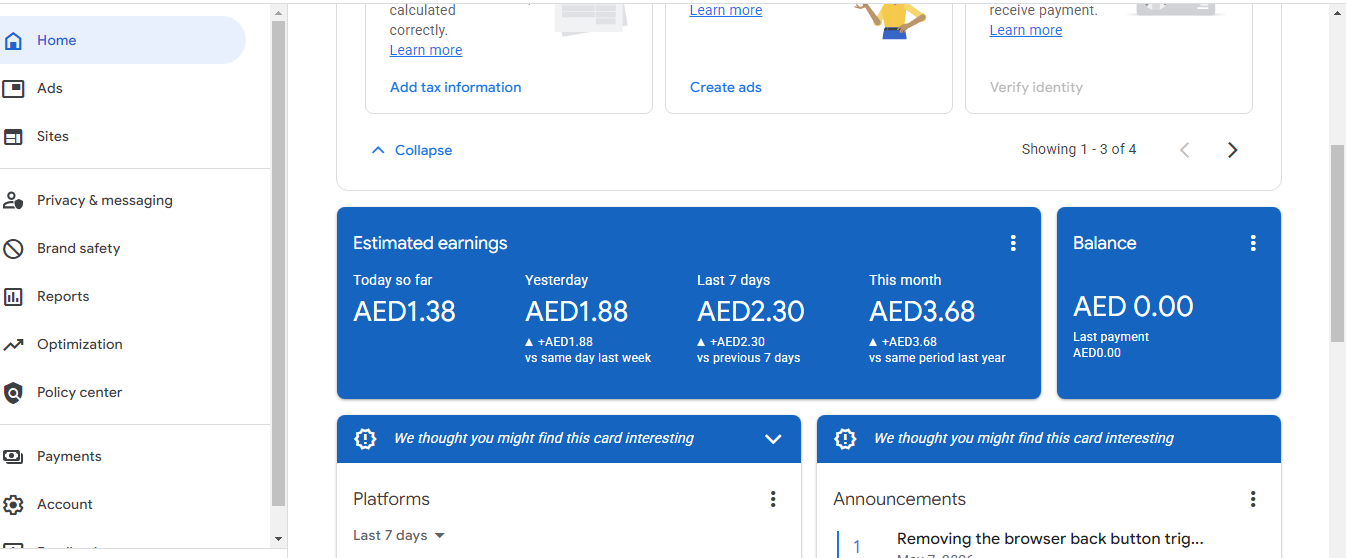
Google AdSense works like this: advertisers bid on your traffic through Google’s auction system. Every time someone clicks an ad (or sometimes just views it), you get a tiny cut. Sounds fair, right? Wrong. Your actual earnings per click called your CPC can range from $0.01 to $50, depending on what industry is advertising and where your reader lives. A click from a U.S.-based lawyer searching “personal injury attorney” might earn you $2. A click from someone in Nigeria reading the same post? Maybe $0.03. And most of your readers aren’t clicking at all the average click-through rate (CTR) for display ads hovers around 0.5%. That means out of 1,000 views, you get five clicks. Multiply that by a $0.50 average CPC, and you’ve made $2.50. Now imagine you’re running a food blog with 50,000 monthly visitors. That’s $125/month before Google takes its cut (which it doesn’t it pays you the net amount after advertiser fees). After hosting, domain, and your time? You’re losing money. A guy in my building works in IT, should know better got burned by this exact thing. He launched a tech tutorial site in 2021, hit 80k monthly views by mid-2022, and proudly showed me his AdSense dashboard: $327 for the month. “Not bad for passive income,” he said. Six months later, he shut it down. Why? Because he spent 12 hours a week writing, editing, and optimizing and was effectively making $6.81/hour. He now does freelance cloud consulting at $120/hour and laughs about the “passive” dream.
The Hidden Costs No One Talks About
Let’s say you ignore the low payouts and push forward anyway. Congratulations you’ve signed up for a part-time job disguised as “monetization.” Here’s what they don’t tell you:
- You must constantly chase traffic. SEO changes, algorithm updates, and competitor spam can tank your rankings overnight. One bad Google update in 2023 wiped out 40% of traffic for thousands of small sites including one of mine.
- Ad placement requires constant tweaking. Too many ads = annoyed readers who bounce. Too few = wasted revenue. There’s no sweet spot that lasts longer than a few months.
- Policy violations are vague and punitive. Google can disable your account for “invalid traffic” if three people from the same IP click ads in an hour even if it’s your cousin visiting from out of town.
And don’t forget: AdSense pays out only once you hit $100. If you’re earning $30/month, that’s over three months of waiting just to see a check. Meanwhile, your hosting bill is due every 30 days.
What Happens When You Actually Try to Live Off It
I know what you’re thinking: “But what if I go viral? What if I hit 100k views?” Let’s run the numbers honestly. Assume you have a solid niche say, personal finance for millennials. You’re getting 100,000 monthly pageviews. Your CTR is a generous 1%. Your average CPC is $1.20 (high for most content outside legal or insurance niches). That’s: 100,000 × 1% = 1,000 clicks 1,000 × $1.20 = $1,200 gross After Google’s fees (already deducted), you get $1,200. Sounds decent until you subtract: - Hosting: $20/month - Domain: $15/year ($1.25/month) - Content creation: If you write 10 posts/month at 2 hours each, that’s 20 hours. At a modest $25/hour freelance rate, that’s $500 in opportunity cost. Net result: You’re either losing $321/month in time value or you’re paying someone else to write, which cuts further into profits. Now compare that to selling a $29 digital product (like a budget template or meal planner). You only need 42 sales to match that $1,200. And once it’s built, it scales without extra work. That’s why Sarah Chen a nurse in Fort Lauderdale who started a side blog about hospital shift hacks quit AdSense after 18 months. She told me: “I was spending more time fixing ad layouts than helping people. Then I made a $12 shift planner PDF. Sold 300 copies in two months. Never looked back.”
The Real Reason AdSense Still Exists (Hint: It’s Not for You)
Here’s the uncomfortable truth: Google doesn’t care if you make $50 or $50,000 from AdSense. The program survives because it serves two masters: 1. **Big publishers** (like Forbes, CNN, or niche media empires) who treat AdSense as one piece of a multi-million-dollar ad stack. They use direct deals, header bidding, and programmatic networks AdSense is just the filler for leftover inventory. 2. **Google itself**, which collects billions in ad revenue while paying out pennies to small creators. In 2023, Google’s ad revenue was $237 billion. Estimated total AdSense payouts? Under $15 billion. That means Google keeps roughly 94% of the ad money flowing through its ecosystem. You’re not a partner. You’re a content farm with a domain name. Think of it like this: AdSense is the vending machine in your office break room. It’s convenient, sure. But the company owns the machine, sets the prices, decides what snacks go in, and pockets 90% of the profits. You get a free bag of chips now and then. And if you shake the machine too hard? It locks you out.
Who Should Actually Use AdSense (And How)
Before you delete your account in rage, hear me out: AdSense isn’t evil. It’s just misused. It *can* work but only under specific conditions:
1. You Already Have Traffic and Another Income Stream
If you’re running a YouTube channel, coaching business, or e-commerce store, AdSense can be a small bonus on your blog. Think of it as finding loose change in your couch cushions. Nice, but not life-changing.
2. You’re in a High-CPC Niche and Target the Right Countries
Insurance, legal services, SaaS tools, and B2B software pay the highest CPCs. But you also need U.S., Canadian, or Western European traffic. If 80% of your readers are from India or Indonesia, your earnings will crater even with great content.
3. You Treat It as Supplemental, Not Primary
The smartest creators I know use AdSense like a side hustle piggybacking on their main offer. They write a post about “best running shoes for flat feet,” include affiliate links to Amazon, and run a few AdSense banners at the bottom. The affiliates pay $5 $20 per sale. AdSense might add $0.50. Combined, it works. But if AdSense is your only plan? You’re building a house on sand.
The Switch-Back Test: What Real People Learned
I talked to five people who ditched AdSense after 1+ years of relying on it. All had one thing in common: they started treating their website as a *business*, not a traffic farm. Maria R., a teacher in Coral Gables, ran a homeschooling resource site with 60k monthly views. She made $400/month from AdSense. Then she created a $19 printable curriculum bundle. In three months, she sold 1,200 copies $22,800. She still runs AdSense. Now it’s pocket money. Another friend, Dev, built a car repair blog. He optimized for AdSense, chased keywords, and hit 150k views. Earned $800/month. Then he launched a $97 video course on diagnosing engine noises. Sold 89 copies in 60 days. Closed his AdSense account last week. What did they learn? **Attention is valuable. But attention + a direct offer is gold. AdSense treats your audience like eyeballs. Smart creators treat them like people.**
Your Mom Test: Would She Get It?
Let’s be real: if your mom opened your website and saw five flashing ads, a pop-up asking for cookies, and barely any useful content above the fold, would she understand what you’re trying to sell? Or would she close the tab and ask, “Honey, why is your site so cluttered?” That’s the litmus test. If a non-tech person can’t instantly see the value and feels annoyed by the ads you’ve failed. Because ads shouldn’t be the point. They should be the afterthought. At techblogs.site, we recommend tools that respect your time and your readers. AdSense? Only if it’s silent, small, and secondary.
So What Should You Do Instead?
Skip the “monetize everything” mindset. Start with this: 1. **Pick one core offer.** A digital product, a service, a membership something that solves a real problem. 2. **Build an email list from day one.** Ads come and go. Your subscribers don’t. 3. **Use AdSense only after you’ve proven demand.** Once you’re making $500+/month from your main offer, add a few non-intrusive ads. Let them pad your income, not define it. And if you’re already deep in the AdSense grind? Run the numbers. Calculate your hourly rate. Ask yourself: “Would I do this job for this pay at a coffee shop?” If the answer is no, it’s time to pivot. Because here’s the final truth: the internet rewards value, not pageviews. And AdSense? It rewards neither just compliance. So ask yourself: **Are you building a business or just feeding Google’s machine?**