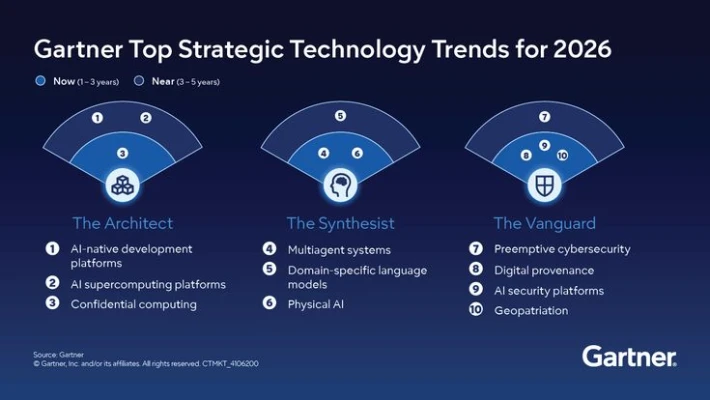
Gartner’s Top Strategic Technology Trends for 2026: How AI Agents Will Change Your Daily Life in the USA
Welcome to techblogs.site, your go-to source for practical, forward-thinking tech insights tailored for everyday Americans. As we look ahead to 2026, one trend stands out above the rest according to Gartner’s latest strategic technology forecast: AI agents. These aren’t just chatbots or voice assistants they’re autonomous digital helpers that can plan, act, and learn on your behalf. And they’re coming to a smartphone, car, or home near you faster than you might think.
For most U.S. consumers, AI has so far meant asking Siri to set a timer or using ChatGPT to draft an email. But by 2026, AI agents will go far beyond reactive responses. They’ll proactively manage your calendar, negotiate bills, coordinate deliveries, and even help you navigate complex healthcare decisions—all while learning your preferences and adapting over time. This shift isn’t science fiction; it’s already unfolding in pilot programs across American cities, from Austin to Atlanta.
What Exactly Are AI Agents?
Let’s break it down in plain English. An AI agent is a software program that doesn’t just answer questions it takes action to achieve goals. Think of it like a highly capable personal assistant who works 24/7, never gets tired, and remembers every detail about your life.
Unlike traditional AI tools that wait for your command (like typing “What’s the weather?”), AI agents operate independently. They monitor your habits, anticipate needs, and execute tasks without constant prompting. For example, imagine your AI agent notices your car’s tire pressure is low during your weekly commute from Phoenix to Tucson. Instead of just alerting you, it automatically schedules a service appointment at your preferred local shop, checks insurance coverage, and reschedules your morning meeting if needed all before you even realize there’s an issue.
This level of autonomy is made possible by combining large language models (LLMs) with decision-making frameworks, real-time data access, and secure integrations with everyday apps and services. And thanks to advances in edge computing and privacy-preserving AI, these agents can run efficiently on your devices not just in distant cloud servers making them faster and more secure for U.S. users concerned about data privacy.
Why 2026? The Perfect Storm of Readiness
You might wonder: Why is 2026 the tipping point? After all, we’ve had smart assistants for over a decade. The answer lies in three converging forces: infrastructure maturity, consumer trust, and regulatory clarity.
First, 5G networks are now widely deployed across major U.S. metropolitan areas, enabling low-latency communication between devices and AI systems. This means your AI agent can react in real time whether it’s rerouting your delivery due to traffic or adjusting your smart thermostat based on sudden weather changes in Denver.
Second, Americans are increasingly comfortable with AI handling routine tasks. A 2024 Pew Research study found that 62% of U.S. adults now use AI-powered tools for scheduling, shopping, or financial planning up from just 38% in 2021. This growing familiarity lowers the barrier to adopting more advanced AI agents.
Third, new federal guidelines like the White House’s AI Bill of Rights and state-level privacy laws such as California’s CPRA are creating clearer rules around data usage and algorithmic transparency. These frameworks give consumers confidence that their AI agents won’t misuse personal information or make biased decisions.
Real-World Examples: How Americans Will Use AI Agents by 2026
Let’s bring this to life with relatable scenarios. Meet Sarah, a working mom in Columbus, Ohio. She juggles a remote job at a fintech startup, two kids in school, and aging parents in Cleveland. By 2026, her AI agent let’s call it “Ava” handles much of the mental load.
Every Sunday evening, Ava reviews Sarah’s upcoming week. It notices her daughter has a soccer game on Wednesday at 4 PM, but Sarah has a critical client call at the same time. Ava automatically proposes three solutions: reschedule the call (with client approval), arrange a rideshare for her daughter via a trusted local service like HopSkipDrive, or suggest recording the call. Sarah picks option two, and Ava handles the booking, payment, and notification to the coach all within minutes.
Or consider James, a small business owner in Portland, Maine. His AI agent monitors his Shopify store, tracks inventory levels, and predicts demand spikes based on local events (like the annual Lobster Festival). When supplies run low, it negotiates bulk discounts with U.S.-based suppliers, files sales tax reports automatically, and even drafts social media posts promoting new arrivals freeing James to focus on customer relationships instead of paperwork.
These aren’t futuristic fantasies. Companies like Google, Microsoft, and emerging startups such as Adept AI and Adept Labs are already testing agent-like capabilities. Amazon’s rumored “Project Pi” aims to turn Alexa into a full-fledged agent by 2025. And Apple’s upcoming iOS updates are expected to integrate on-device