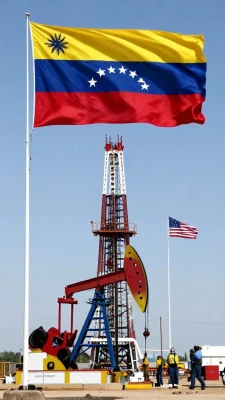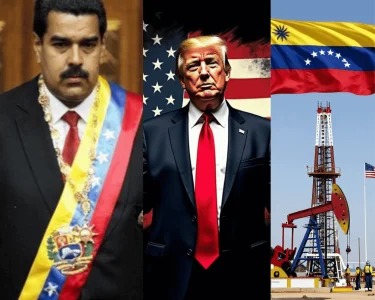
Venezuela has long been known as one of the richest countries in the world in terms of oil reserves. The country has one of the largest proven oil reserves globally, estimated at more than 300 billion barrels. Oil is not only the backbone of Venezuela's economy, but also a key point in its international relations, especially with the United States.
Historically, Venezuela was one of the top oil exporters to the United States. In the early 2000s, the United States imported millions of barrels of oil per day from Venezuela, making it a major player in the global oil market. The relationship was mutually beneficial: Venezuela received income from its oil exports, while the United States benefited from a steady supply of crude oil.
The country's relations with the US began to deteriorate, and the oil trade became the focal point of the growing tensions, when the Bolivarian Revolution took hold in Venezuela in 1999. After the rise of Hugo Chávez, and then Nicolás Maduro, policies in the Venezuelan oil industry led to destabilizing economic reforms. During this time, the United States for years imposed economic sanctions on Venezuela, which were aimed at the oil sector but didn't quite get the results needed, an attempt to push the govt to sort out human rights and democratic problems.
These sanctions have significantly affected Venezuela's oil production and export capacity. Venezuela's output, which once produced more than 3 million barrels per day, has fallen to less than 1 million barrels per day in recent years. Refineries that depended on Venezuelan crude had to seek alternatives from other countries such as Canada, Saudi Arabia and Mexico.
The US, on the other hand, has been trying to reduce its dependence on Venezuelan oil, especially with its increasing domestic production. With the shale oil boom in the US, the need for imports decreased, giving the US greater influence in international oil markets. This change has weakened Venezuela's economic position and made the oil industry vulnerable to global market fluctuations.
Despite these challenges, Venezuela still plays an important role in the global oil supply. Its reserves are attractive to other international investors and countries looking for reliable sources of oil. Countries such as China, Russia and India have stepped in to fill the gap left by the US, sustain Venezuela's oil exports and provide financial support to the country's struggling economy.
This situation highlights the complex interaction between energy, politics and economics. For Venezuela, oil is not just a commodity; It is a tool of diplomacy and influence. For the United States, controlling energy imports and maintaining stable international relations is essential for economic security. The Venezuela-USA oil relationship shows how energy resources can shape global politics and affect the millions of people who depend on them.
In conclusion, Venezuela's oil industry and its relationship with the United States reflect the challenges of global energy policy. Political instability, sanctions and changing market dynamics have made a once prosperous relationship more complex
Beyond just trade and economics, Venezuelan oil has important geopolitical implications. The country's oil wealth gives it strategic importance on the global stage, making it a subject of interest to major powers such as the US, China and Russia. For example, while US sanctions have banned US companies from doing business with Venezuela, China and Russia have provided loans, investments and technology to sustain production. It shows how oil is not only an economic resource, but also a diplomatic tool that shapes alliances and international politics.
Venezuela's domestic challenges also affect the oil industry. Years of poor management, corruption and lack of investment have led to aging infrastructure and declining production capacity. Even with the largest reserves in the world, the country is struggling to meet global demand. This creates a paradox: Venezuela has enormous potential wealth, but its economy faces serious difficulties.
Meanwhile, the United States continues to adapt its energy strategy. With increasing domestic shale oil production and partnerships with other oil-exporting countries, the United States has diversified its supply and reduced its dependence on Venezuelan crude. However, any stabilization in Venezuela's political or economic situation could quickly change the dynamic, as its oil reserves are among the most important in the world.
Ultimately, the story of Venezuela and the United States in the oil sector highlights how natural resources, governance and global politics are deeply interconnected. The future of this relationship will continue to affect energy markets, international relations and economic stability in both countries and beyond.