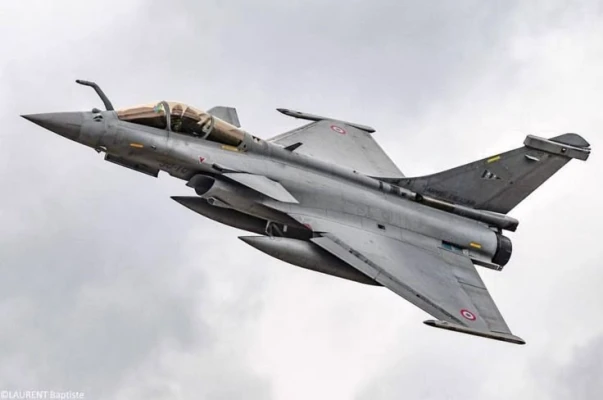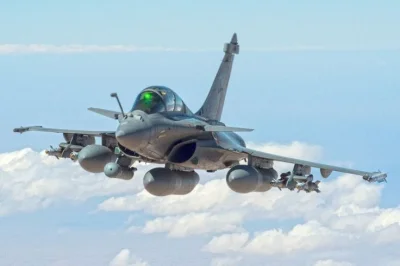
When you think of modern fighter jets, a few famous names probably come to mind. But there’s one European star that doesn’t always get the loudest headlines, even though it’s one of the most capable and versatile warplanes in the world: France’s Rafale.
Pronounced “Ra-fal” (like “golf” but with an ‘R’), this sleek, twin-engine fighter is the pride of the French aerospace industry. Built by the legendary company Dassault Aviation, the Rafale has a simple but powerful motto: “Omnirole.” This fancy word just means it can do almost any job you can imagine for a fighter jet, and it can do several of them on the same mission. It’s the ultimate multi-tool for air forces.
Let’s take a deep dive into what makes the Rafale so special, why several countries are choosing it, and how it serves as the guardian of French skies (and seas!).
A Jet Born from French Independence
To understand the Rafale, you need to understand a bit of French history in aviation. France has always prized its ability to defend itself with its own technology. After leaving a joint European fighter project in the 1980s, France decided to go its own way. The goal was ambitious: create a single aircraft that could replace seven different types of older fighters and bombers in the French Air Force and Navy.
The first Rafale prototype took flight in 1986—a testament to its advanced, forward-thinking design. After years of testing and development, it officially entered service with the French Navy in 2001 and the French Air Force in 2006. Today, it is the cornerstone of French air power.
This is the Rafale’s biggest selling point. While some fighters are specialists, the Rafale is the ultimate generalist. Imagine a surgeon who is also a master carpenter, a brilliant lawyer, and a champion race car driver. That’s the Rafale in the air.
Here’s a breakdown of the many hats it wears:
1. Air Superiority Fighter (The Duelist):
This means it is built to win dogfights and control the skies. It is agile, fast (capable of reaching Mach 1.8, or over 1,300 mph), and equipped with a powerful radar. Its most feared weapon in this role is the Meteor missile. This beyond-visual-range missile can engage enemy aircraft from over 100 kilometers away, long before the enemy even knows the Rafale is there.
2. Ground Attack / Bomber (The Striker):
The Rafale can carry a devastating load of bombs and missiles to destroy targets on the ground. It can perform precision strikes in all weathers, day or night, using laser-guided bombs or GPS-guided weapons. It has been used in combat operations over Afghanistan, Libya, Mali, and Iraq with great success.
3. Naval Fighter (The Carrier Expert):
This is a rare and difficult skill. The Rafale M (for Marine) is designed to operate from the deck of an aircraft carrier, France’s nuclear-powered Charles de Gaulle. Landing on a short, moving runway in the middle of the ocean is one of aviation’s hardest tasks. The Rafale M has a strengthened frame, a tailhook to catch arresting wires, and a special “jump strut” nose gear to help it launch off the carrier’s ramp.
4. Reconnaissance Plane (The Eye in the Sky):
The Rafale can carry special camera pods and sensors under its belly. These pods, like the Areos Reconnaissance Pod, contain high-resolution cameras and infrared sensors to take detailed photos of enemy territory, day or night, from high altitude and at high speed.
5. Nuclear Deterrence (The Guardian):
One of its most serious roles is carrying France’s airborne nuclear deterrent, the ASMP-A missile. This gives France a powerful and independent nuclear strike capability, a key part of its national defense strategy for decades.
The magic happens when you combine these roles. A single Rafale on a mission could be sent to patrol a border (air superiority), then be redirected to strike a terrorist camp (ground attack), and on its way home, use its pod to photograph a suspicious facility (reconnaissance). This “swing-role” capability is a huge force multiplier.
You can’t be this versatile without some serious technology.
The Engines: It is powered by two Snecma M88 engines. Two engines mean more power, better safety over water or remote areas, and great acceleration. They are also known for being relatively easy to maintain.
The Brain: The Rafale’s secret weapon is its RBE2 Active Electronically Scanned Array (AESA) radar. Unlike old radars that mechanically spin, this radar’s beam moves electronically at lightning speed. It can track many targets at once, look up, down, and sideways, and even work as an electronic warfare system to jam enemy signals.
The Cockpit: The pilot sits in a “glass cockpit” dominated by large, customizable touchscreen displays. The design follows the HOTAS principle—Hands On Throttle And Stick. This means the pilot can control almost every critical system without ever taking their hands off the flight controls, keeping their focus outside the cockpit during combat.
Low Observability: While not a full “stealth” jet like the American F-35, the Rafale is built with “low observable” features. Its shape, use of composite materials, and special coatings help reduce its radar signature, making it harder for enemies to detect and lock onto.
The SPECTRA System: This is the Rafale’s suit of armor. SPECTRA is an integrated electronic warfare and self-protection system. It constantly monitors the surroundings, detects missile launches and enemy radar locks, and can automatically deploy jammers and decoys to keep the pilot safe. Pilots call it their “guardian angel.”
The Human Element: What Do Pilots Say?
Technology is nothing without the person in the cockpit. The reports from Rafale pilots are consistently glowing. They describe it as an intuitive, agile, and “pilot-friendly” aircraft. Its flight controls are responsive, and its advanced systems handle a lot of the complex work, reducing pilot workload. This lets the human focus on tactics and decision-making, not just managing the machine. They trust its ruggedness, its powerful engines for quick getaways, and the life-saving SPECTRA system.
The Rafale vs. The World
People often ask how it stacks up against other jets like the Eurofighter Typhoon, American F-35, or Russian Su-35.
Vs. Eurofighter Typhoon: The Typhoon is often considered a slightly more agile pure air-superiority fighter. However, the Rafale is seen as more versatile from the start, with built-in naval capability and a wider range of ground-attack options.
Vs. F-35 Lightning II: The F-35 has superior stealth technology and sensor fusion. The Rafale is less stealthy but is often considered more agile, has better range/payload in some configurations, and offers a different strategic partnership model without some of the F-35’s usage restrictions.
Vs. Su-35: The Russian Su-35 is extremely agile and powerful. The Rafale counters with far superior and more reliable avionics, radar, and long-range missiles, along with precision strike capabilities the Su-35 lacks.
The point isn’t that the Rafale is always “the best” in one single category, but that it is exceptional across the board. It offers a near-perfect balance of capabilities without a single glaring weakness.
Conclusion: The Elegant Warrior
The Rafale is more than just a collection of metals, wires, and weapons. It is a symbol of French engineering philosophy: independent, innovative, elegant, and ruthlessly efficient. It doesn’t scream for attention, but its combat record, growing list of customers, and unparalleled versatility speak volumes.
In a world of specialized tools, the Rafale stands out as the ultimate master of all trades. It protects French sovereignty, projects power across the globe, and assures allies. It is, without a doubt, one of the greatest and most complete fighter jets ever built.